-
Submenu: Academics
-
Submenu: Research
-
Submenu: The Chair
- FacultiesSubmenu: Faculties
Schnelleinstieg
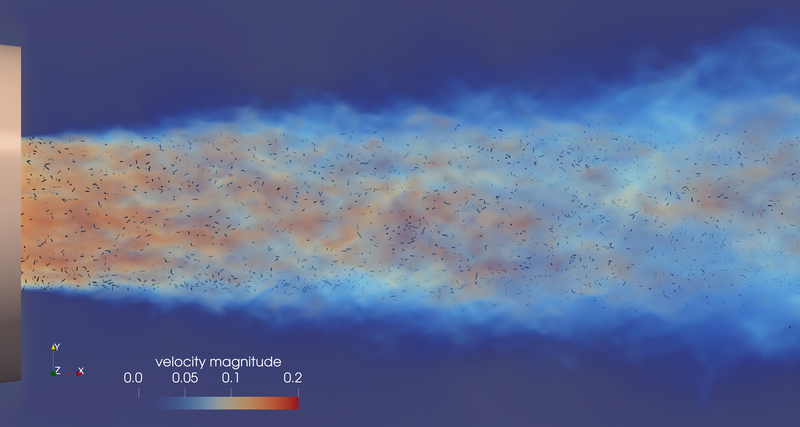
Modelling and Analysis of Non-Spherical Particle-Laden Flows
In many industrial and environmental processes, small solid particles are transported by a gas or liquid.
In simulations, these particles are often simplified as perfect spheres.
Real particles, such as pulverised wood used in solid-fuel combustion, often have more elongated and irregular shapes.
Due to their anisotropic shape, these particles align differently as they move, which alters the way they mix and react.
This research project uses state-of-the-art simulations to understand the behaviour of non-spherical particles and to develop improved models.
Modelling of turbulent bubbly flows
Bubbly flows play an important role in many industrial applications.
The accurate prediction of the fluid dynamics and the gas transport in such systems is crucial for their design and optimization.
The solver framework m-AIA features two different approaches for the simulation of turbulent bubbly flows, based on the Eulerian-Eulerian and the Eulerian-Lagrangian approach.
These methods have successfully been applied for the simulation of the electrochemical machining (ECM) process.
The results provide insights into the underlying physical phenomena and are used to determine optimized process parameters regarding geometrical accuracy and machining efficiency.

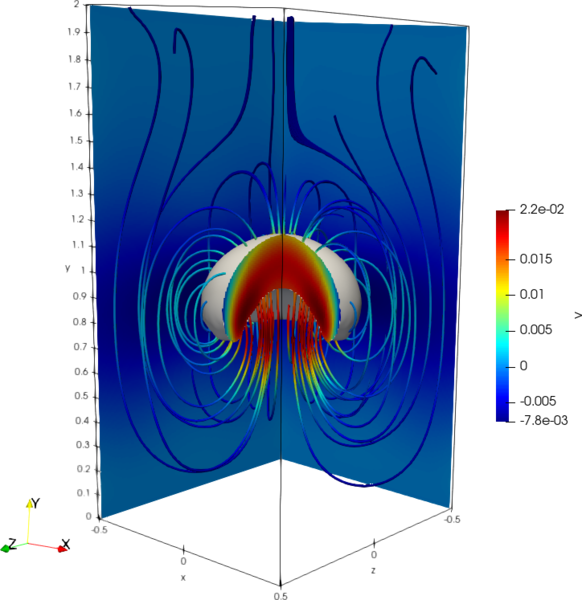
Development of novel methods to simulate gas-liquid flow problems
For gas–liquid flows with higher volume fractions, the dynamics of the gas and the behavior of the phase interface become increasingly important. In this case, the governing equations are solved for both the gas and liquid phases, while the interface is explicitly captured to account for the effects of surface tension. To enable simulations of such flows, novel numerical methods are developed. These models are applied to complex technical problems, such as flow behavior in the sealing gap of oil-flooded twin-screw compressors.