-
Submenu: Academics
-
Submenu: Research
-
Submenu: The Chair
- FacultiesSubmenu: Faculties
Schnelleinstieg
Aeroacoustics and Noise Reduction Using Porous Materials
Reducing aircraft noise has become an increasingly important goal in the development of future commercial aircraft. Stricter airport noise regulations require new technologies that can lower the sound emissions generated during flight operations. This is particularly relevant during approach and landing, when aircraft engines operate at low power and the relative contribution of airframe noise becomes significant. One important source of such noise is the landing gear, which consists of multiple structural components exposed to the airflow.
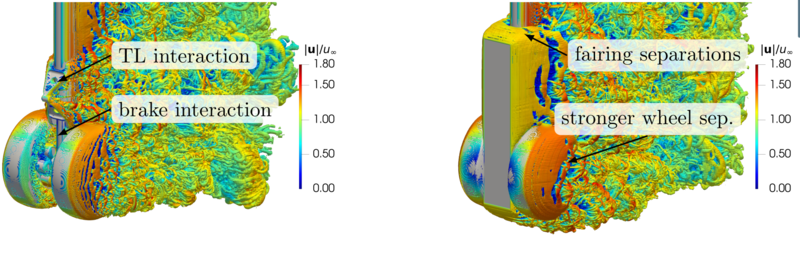
When air flows around the landing gear, it encounters several blunt components such as struts, wheels, and connecting elements. These structures cause the airflow to separate, creating turbulent wakes behind them. As these turbulent wakes interact with downstream components of the landing gear, they generate complex pressure fluctuations that radiate as broadband noise. Because the landing gear is exposed and geometrically complex, it represents a challenging but important target for noise reduction strategies.
To better understand these noise generation mechanisms, researchers often rely on advanced numerical simulations together with experimental studies. Well-defined benchmark configurations, such as simplified landing gear models, are frequently used to validate simulation methods and to investigate the aerodynamic and acoustic behavior of these systems. Studies have shown, for example, that adding certain structural components to a landing gear configuration can significantly increase the overall sound levels due to additional wake interactions.
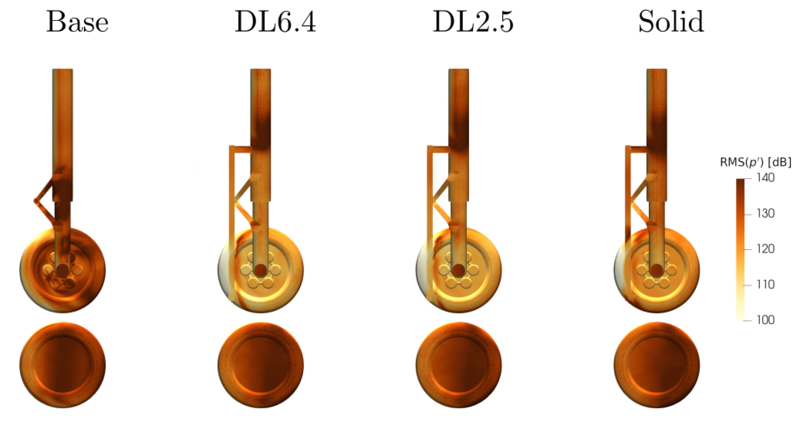
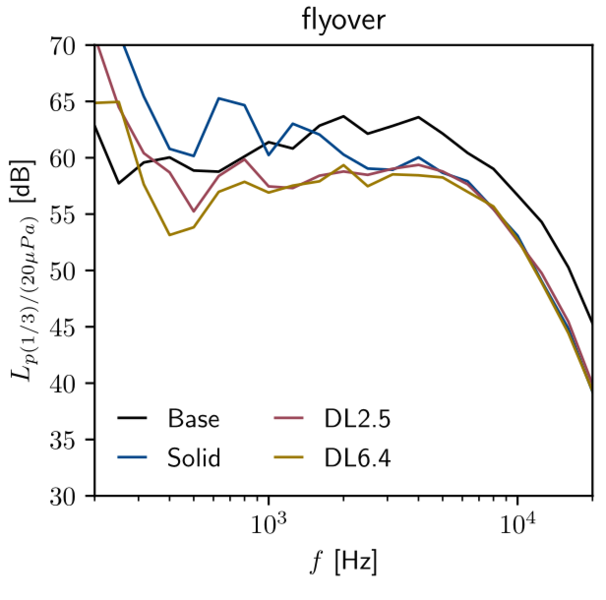
One promising approach for reducing airframe noise is the use of porous or perforated materials. When placed upstream of noise-generating components, porous structures can modify the turbulent flow before it reaches downstream surfaces. This can weaken the strength of the wake interactions that are responsible for sound generation. Experimental studies have shown that porous screens or perforated fairings can lead to measurable reductions in far-field noise levels.
Compared to solid fairings, porous structures can offer additional advantages such as reduced weight and improved airflow for cooling systems, for example for aircraft brakes. However, the effectiveness of these structures depends strongly on their porosity and internal structure. Some studies have shown that increasing porosity may reduce the noise mitigation effect, indicating that the design of such materials must be carefully optimized.
Current research therefore focuses on better understanding how porous materials interact with turbulent flows and acoustic fields. By combining detailed simulations with experimental investigations, researchers aim to develop design guidelines for porous noise-reduction concepts that can be applied to realistic landing gear configurations and other airframe components.